
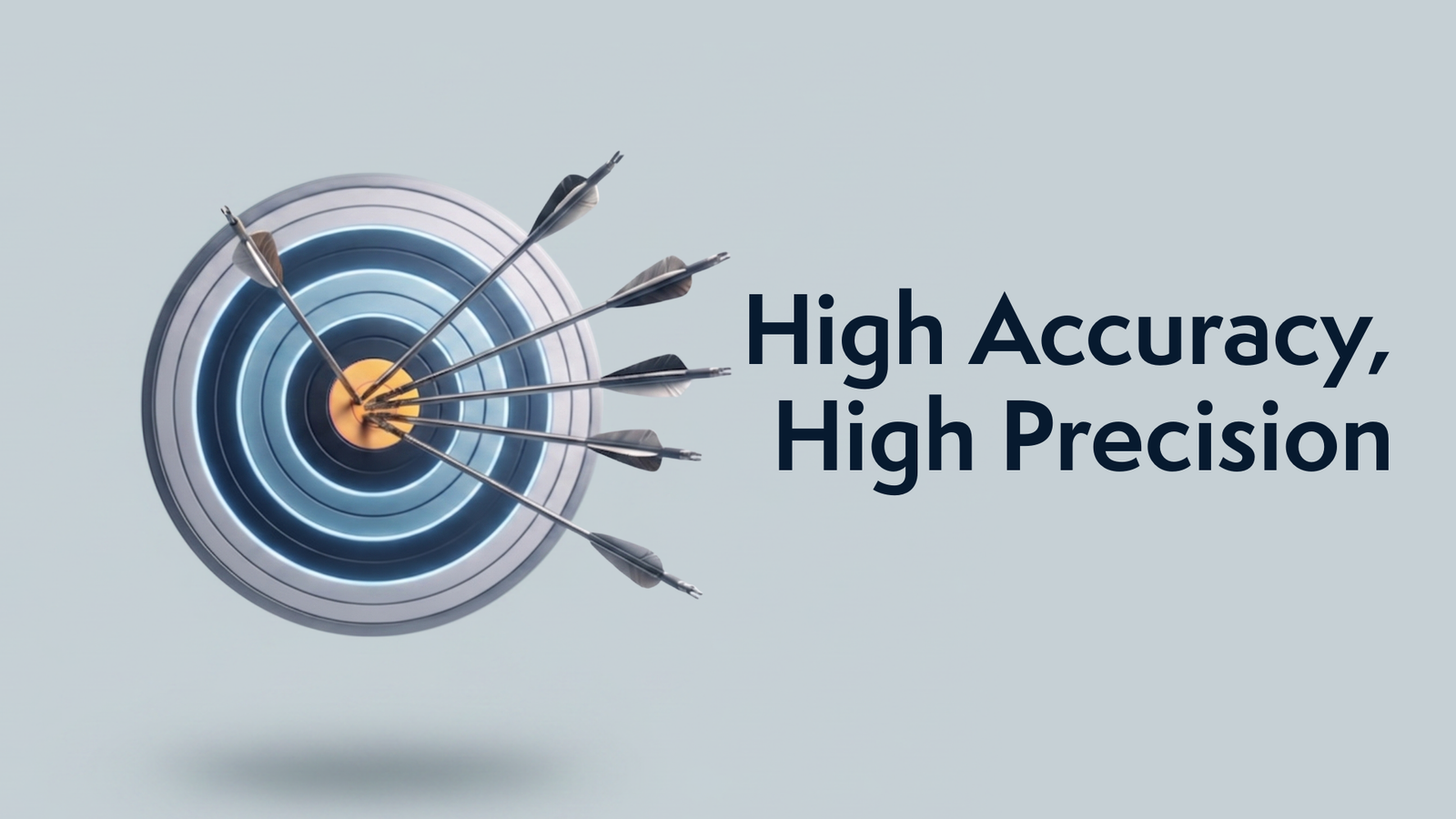
In metrology, both accuracy and precision reflect how close a measurement is to a real or reference value, but these two terms do not mean the same in practice. Accuracy refers to how closely a measured value aligns to a known or accepted value. Precision refers to the consistency of repeated measurements; that is, how reproducible measurements are, even if they deviate from the accepted value. Measurements that are both accurate and precise are reliable and consistent.
The bull’s eye analogy is the usual visual representation of what accuracy and precision mean: an arrow hitting close to the innermost ring represents accuracy, while a tight cluster of arrows, even if off-centred, indicates precision.
Accuracy and precision are fundamental concepts each serving distinct purposes in the fields of clinical research, drug engineering and manufacturing, medicine and, of course, medical translation.
In clinical research, the validity of scientific experiments largely depends on the accuracy and precision of the data collected. An experiment with precise data allows for reliable repetition and comparison, while accurate data ensures that the findings truly reflect reality.1
Achieving accuracy in measurements during clinical trials involves the rigorous use of standards and procedures that compare outcomes to established known values. High precision in measurements means little variability between successive results.1
In drug engineering and manufacturing, misunderstanding of the distinction between accuracy and precision may lead to specification errors, quality failures and costly reworks.2
Accuracy describes how close a manufactured feature comes to a target value, whereas precision describes the repeatability or consistency of measurements or processes. The distinction becomes critical in the pharmaceutical industry, especially in manufacturing, quality control, and lab testing.2
In healthcare and biomedical applications, accuracy and precision in measurement results directly influence clinical decisions such as diagnosis, treatment and prevention.3
In medical practice, accuracy refers to how close a health measurement or diagnosis is to the true value, and precision is the reproducibility of those repeated results. Both accuracy and precision are the foundational pillars of patient safety, as they determine whether a physician makes an accurate diagnosis or prescribes the correct medication.3
ACCURACY AND PRECISION IN MEDICAL TRANSLATION
What is accuracy in medical translation?
Accuracy in medical translation is unequivocally hitting the bull’s eye. It means faithfully conveying the original meaning without content and purpose distortion, omissions and additions due to lack of subject matter knowledge.
If medical translators have domain knowledge aiding in-depth understanding of the source text, they will undoubtedly reproduce source meaning (content and form) in a faithful, exact and reliable manner regardless of the complexity of the source text.
What is precision in medical translation?
Precision in medical translation refers to the language and terminology used to consistently produce accurate translations that suit the needs of different audiences. Medical translators offering precise translations are able to adapt language and terminology to better communicate source meaning. Translating medical (technical) content for healthcare professionals is not the same as translating diseased-focused and clinical trial material for patients.
In the first case, medical translators will use technical language and specialised terminology to properly and precisely transmit what scientific researchers, peer reviewers, KOLs, among others, have to communicate to the medical and scientific community. In the second case, medical translators will have to adapt language, simplify it to match the reader’s literacy level, and use, whenever possible, non-technical terms to aid readability while staying compliant with patient-facing material regulation.
At Vital Translations, we believe that the safest and most effective combination in translation is High Accuracy and High Precision.
How is the combination of high accuracy and high precision achieved?
Simple (or not so simple): through knowledge.
Linguistic Knowledge
Having language expertise which implies mastering both source and target language structural components like morphology, syntax, semantics and pragmatics, and having an in-depth understanding of how human language actually works beyond words to be able to adapt language and terminology based on the translation target audience, always having in mind that the main objective of the translation is to work as a communication bridge between one language/culture and another.
Domain Knowledge
Without subject matter knowledge, the translation process becomes a human or machine automatisation, the mere transfer of words, that is, literal translations that fail at conveying implicit and explicit meaning of the original text. Domain knowledge, gained either by study or hands-on experience, is what aids understanding of highly technical texts. If translators understand what they are translating, they can 1) raise the proper questions to guide their linguistic decisions, 2) quickly orient topic research and terminology search and 3) come up with translations that accurately and precisely reflect the content (meaning and purpose) of the original text.
Accuracy and precision are both crucial concepts if the main objective of translation is to help clients properly reach specific audiences and communicate with them effectively.
When it comes to the translation of your key scientific, regulatory, educational or promotional material, how much are you willing to risk?
Vital Translations is a language service provider (LSP) with 15+ years of experience in the translation industry offering accurate and precise translations for the healthcare and pharmaceutical industries.
Check our services and request a free quote.
References:
1. Precision vs Accuracy in Metrology: Understanding Measurement Quality https://advancedspectral.com/precision-vs-accuracy/
2. Accuracy vs Precision: Critical Measurement Differences Explained https://bangid.com/knowledge-base/understanding-the-difference-between-accuracy-and-precision-in-engineering-and-manufacturing/
3. Accuracy vs Precision: A White Paper Series on Biomedical Metrology, Calibration, and Trust https://www.bitsbiomedical.com/accuracy-vs-precision/